Pages

Ads 468x60px

Featured Posts Coolbthemes

Tuesday, 13 September 2016

Nicki Minaj 'In Shock' Over Eminem Collaboration 'Roman's Revenge'

After rejecting one beat, Em 'picked up the phone' for a Swizz Beatz track, Nicki says on 'RapFix Live.'
 
"It was Roman ... and it was Slim Shady," she told MTV News' Sway while speaking in a British accent during her appearance on "RapFix Live."

The real Slim Shady? "The real Slim Shady," she confirmed. "It was the most fun song on Pink Friday. It gave me life. Absolutely, darling."

The track had long been in the works, she revealed. Swizz Beatz produced the number, and she held onto the track for months. The Queens femcee sent Eminem another record first in hopes of soliciting a collaboration with the Detroit superstar.

"We went out on a whim and put it in the air like, 'It'd be great if he would collaborate with us,' " Nicki Minaj said. "I remember I kept talking about it, and I thought, 'It can't hurt.' I sent him one record, and he didn't love it. He didn't say, 'I don't love it'; he just said, 'Can you send me something that's a little more me?' I sent him an e-mail and thanked him for that, just having enough respect. Sometimes people don't respond. He had the respect, at least, to treat me like a peer."

Eventually, Nicki revisited the Swizz track and completed the song. She wasn't sure if she wanted a feature on the track, because she thought the song was so good as it stood. After thinking it over, however, she decided to reach out to Em.

"He picked up the phone for that one," she said.

According to Nicki, the Recovery MC was extremely detailed about his plans. The two worked out a new chorus after clearance issues killed the first one. Then they wrapped the number, which features [article id="1650705"]MTV News' 2010 Hottest MC in the Game[/article] and [article id="1650583"]#6 on the list[/article].

"Even right now, I'm in shock," she said of the collaboration.

What do you think about Em and Nick working together? Let us know in the comments!

Monday, 1 February 2016

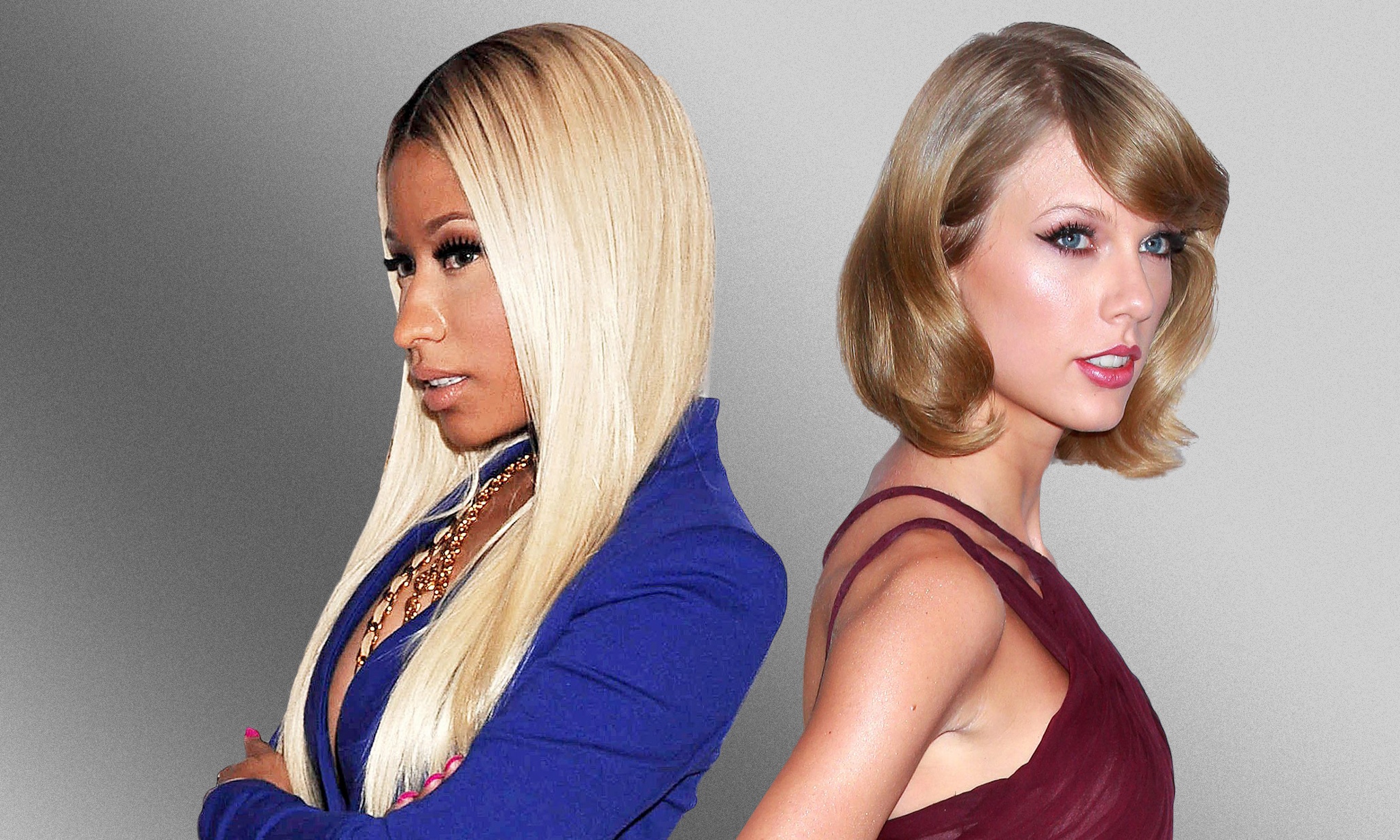
The Nicki Minaj debate is bigger than Taylor Swift's ego

When Minaj tweeted about black artists being sidelined by the music industry, it sparked an online spat with Taylor Swift. Didn’t the misjudged global reaction rather prove her point?


Nicki Minaj and Taylor Swift. Photograph: Rex/Shutterstock/Guardian montage

“If I was a different ‘kind’ of artist, Anaconda would be nominated for best choreo and vid of the year”. And there, in a single tweet on Tuesday, rapper Nicki Minaj kicked off a conversation about race, feminism, and the music industry that might have been ignored had it not been derailed by the planet’s biggest pop star, Taylor Swift.

“When the ‘other’ girls drop a video that breaks records and impacts culture they get that nomination,” wrote Minaj. Her point is one about the unspoken bias and sometimes out-and-out racism of an industry that has profited from the talent of black artists without giving them their dues. Or, at the very least, a trophy of an astronaut from MTV.

Swift, possibly unable to imagine a debate bigger than her or her ego, took instant personal offence and tweeted, in po-faced hurt: “@NICKIMINAJ I’ve done nothing but love & support you. It’s unlike you to pit women against each other. Maybe one of the men took your slot.”

Minaj responded: “‘Huh? U must not be reading my tweets. Didn’t say a word about u. I love u just as much. But u should speak on this @taylorswift13.” And she should. Minaj invited Swift to wield her mighty power to call out the music industry – or even just MTV – for its racial bias, unconscious or otherwise. Because, of course, Swift is the one-woman saviour of pop. Last month, she wrote an open letter complaining about Apple’s new music streaming service refusing to pay artists for the first three months. The world’s biggest tech brand buckled in 24 hours.

Yet, instead of listening to Minaj, her supposed friend and collaborator, Swift responded: “@NICKIMINAJ If I win, please come up with me!! You’re invited to any stage I’m ever on.” A tweet that, at best, could be read as patronising and ignorant; at worst, vacuous and self-absorbed.
Watch Nicki Minaj’s video for Anaconda.

The broader point Minaj is making is clear: throughout music history, black women aren’t recognised in the popular music canon in the same way their white counterparts are. As Minaj tweeted: “If your video celebrates women with very slim bodies, you will be nominated for vid of the year … I’m not always confident. Just tired. Black women influence pop culture so much but are rarely rewarded for it.”

Yet without Swift making the story about her, Minaj’s tweets would likely have been talked about by sections of Twitter, music journalists and fans, before everyone shrugged and moved on. The wider reporting of the story has since twisted what is a valid conversation – about what makes a white artist outstanding, and why a black artist isn’t allowed to compete on the same terms. The coverage has reduced the debate to a catfight between two massive female stars, where Swift is the winner, taking down another woman who needs to know her place. It is insidious and crass.

In this retelling, Minaj is archetyped as the angry black woman, while Swift is bizarrely cast as the feminist hero. Pictures – deliberately selected, remember – to illustrate the story online by Glamour magazine, the Daily Mail, andEntertainment Weekly (some of them since deleted) show Minaj pulling faces or looking daft, or simply focus on her bum. The underlying message is that she’s wacky, unhinged and clearly the hyper-sensitive loser here. Ones of Swift, by comparison, show her looking soft, delicate and “unthreatening” – the victim under attack.

It didn’t stop at picture editing. Consider the bias on show when Glamour tweeted its take: “@taylorswift13 shut down @NICKIMINAJ on Twitter and it was WONDERFUL.” A sentence that embodies everything wrong with white feminism’s refusal to acknowledge, let alone understand, that unless “the struggle” in 2015 is intersectional (you know, taking in priorities that aren’t just about white women in the west serving white women in the west), it is irrelevant. To no credit, Glamour later retweeted the story as: “@taylorswift13 and @NICKIMINAJ embroiled in Twitter row.”
Watch Taylor Swift’s video for Bad Blood.

Anaconda was a video brilliantly calculated to be parodied and memed, blogged and talked about endlessly on its release last year. The fact that it was watched 19.6m times in 24 hours and smashed records to become the most watched video ever on Vevo was a bonus. As Minaj pointed out: ‘U couldn’t go on social media w/o seeing ppl doing the cover art, choreo, outfits for Halloween ... and impact like that and no [Video of the Year] nomination?”

Swift’s video for Bad Blood was pitched to have the same effect: in it, she gathers a clique of her bezzies, including Lena Dunham, Cara Delevingne and Ellie Goulding, and stomps about in PVC, sexily pouting and kickboxing the girl (widely assumed to represent Katy Perry) who wronged her. On its debut in May, the video broke Minaj’s record and picked up more than 20m views in 24 hours;MTV has shortlisted it seven times in the VMAs, including for best video, art direction and director of the year. Anaconda is up for best hip-hop and best female video.

As blogger oneofthosefaces put it: “Miley spent the whole of 2013 building an adult career on the back of strapping on a fake booty and twerking her way to stratospheric success. If you rundown Nicki’s tweets and retweets, she was drawing parallels, not suggesting any of this year’s nominees had taken her spot. Her argument was specifically about the difference in the way white bodies and black bodies are portrayed. It’s an argument she’s made before, when she compared ‘acceptable’ white girls in bikinis to her ‘unacceptable’ Anaconda cover art.”

To put it another way: Minaj’s arse is considered too sexual, too crude, too shockingly unpalatable when she deliberately and provocatively, puts it on show, whereas the same pose struck by white models is taken as sexy, friendly and OK.

At the time of writing, “Nicky Minaj + Taylor Swift + VMA” turns up 2.8m results on Google News. Minaj, apparently unfazed by the column inches mounting, later contradicted headlines stating that she had taken “a jab” at Swift: “Nothing I said had to do with Taylor. So what jabs? White media and their tactics. So sad. That’s what they want.”

For its part, the response from “white media” has been inevitably prickly and sensitive about being called out by Minaj; as if being challenged on racial bias is worse than that bias existing in the first place. It’s a bizarre state of affairs, perfectly summed up by Taylor Swift’s final response to the matter: closing the conversation down by unfollowing Nicky Minaj on Twitter.

Monday, 11 January 2016

Nicki Minaj - Trinidadian-born singer, songwriter, and television personality

Performing Arts

Born Dec. 8, 1982, St. James, Trinidad and Tobago), American rap singer and songwriter Nicki Minaj in 2013 saw her career skyrocket as she claimed title to a record 44 appearances—the most by a female rapper—on the Billboard Hot 100 chart. Though she had remained visible since 2012 as a judge on the reality television singing competition American Idol, the savvy star announced that she would not tour in 2013 but would instead concentrate on creating her third album. Minaj combined colourful wigs and risqué clothes to create a bold persona to complement her flowing, quick-spoken rap style. Gaining attention for her sexually explicit lyrics and tough attitude, she embraced the shock value of her work to help guide her career onto an upward path. She was also known for her preference for the colour pink, a predilection that she used in branding her albums and such consumer items as her Pink Friday perfume and Pink Pill speakers (sold by AT&T).

Onika Tanya Maraj was about five years old when her family moved to Queens, N.Y., from Trinidad and Tobago. Her childhood was dominated by a violent drug-addicted father, and she spent time creating fantasies for herself that would allow her an escape from her tumultuous life; she adopted a new name, Nicki Minaj, from that practice. Other creative outlets included writing her first rap song when she was 12 years old and pursuing acting at New York City’s Fiorello H. LaGuardia High School of Music & Art and Performing Arts.

Minaj entered the music business as a backup singer for local aspiring rap singers in New York City. She included videos of her work on her Myspace page, which was seen by a local record label. Minaj eventually came to the attention of rapper Lil Wayne, and the two worked on some mixtapes (recordings), with the first, Playtime Is Over, appearing in 2007. As other mixtapes were released, Minaj’s exposure grew, and the next year she was named Female Artist of the Year at the Underground Music Awards. In 2009 she signed with Young Money Entertainment, the label founded by Wayne. Her first album for Young Money, Pink Friday (2010), made it to the top of the Billboard 200 chart.

In 2012 Minaj released her second album, Pink Friday: Roman Reloaded. It featured the single “Starships,” which won best female video at that year’s MTV Video Music Awards presentation. Also in 2012 she caused controversy on American Idol with her blunt, opinionated judging style and with her frequent disputes with fellow judge Mariah Carey.

Nicki Minaj Biography

Nicki Minaj Biography

Born on December 8, 1984, Nicki Minaj is an Indo-Asian descent. She grew up in a troubled family with a father who was a drug addict. She studied singing and acting at LaGuardia High School but like many other big stars, she began her singing career as a backing vocalist for other artists.

Her talent was first spotted by Young Money CEO Fendi on MySpace and later was recruited for The Carter Edition of Young Money's "The Come Up" DVD series. Her rapping skill caught Lil Wayne's attention who later on tagged her for a number of collaborations in his mixtapes.

In April 2007, Nicki released her first mixtape "Playtime Is Over". Weezy lent his vocal on one of the songs. A year later, she dropped another mixtape "Sucka Free" which landed her as Female Artist of the Year at the Underground Music Awards.
After the arrival of her third mixtape "Beam Me Up Scotty" which received positive reviews from BET and MTV, she appeared in a bunch of joint tracks for studio albums from the likes of Ludacris, Usher, Mariah Carey and, of course, her mentor Weezy.

Nicki finally released her debut single "Massive Attack" in March 2010. She teams up with Sean Garrett on the hook and tags her BFF Amber Rose aka Kanye West's girlfriend when shooting the music video.

The singles "Your Love" and "Check It Out" then preceded the release of her official debut album, "Pink Friday", which was released later in 2010. It peaked at No. 2 on Billboard 200 and went platinum. She earned a handful of 2011 Grammy nominations, including Best New Artist, Best Rap Album, and Best Rap Performance.

In early 2012, she released "Starships" as the first offering from her sophomore effort, "Pink Friday: Roman Reloaded", an album built around her devil-may-care alter ego "Roman Zolanski." Boasting guest appearances from Nas, Wayne, Rick Ross, Chris Brown and Beenie Man, the album hit No. 1 on the U.S. album charts. In addition to "Starships", the album spawned other hits like "Pound the Alarm" and "Va Va Voom" which reached the Hot 100's top 40. By the end of 2012, Minaj was announced as a judge for the twelfth season of "American Idol", although she left at the end of the season.

In 2013, Minaj announced that she would be releasing a new album in 2014. "Lookin A**" was released in March 2014 as the first single off the album which was later titled "The Pinkprint". "Pills N Potions" was released a few weeks later as the second single. However, the biggest hit from the album is so far the third single, "Anaconda". Featuring a sample of Sir Mix-a-Lot's 1992 hit "Baby's Got Back", the ode to booty spawned a twerk-filled music video that eventually became the most-viewed clip on YouTube in 24 hours period. The song itself peaked at No. 2 on Hot 100. "The Pinkprint" album is coming out on December 15.


25 Facts You Probably Didn’t Know About Nicki Minaj

Nicki Minaj is the biggest female rap star in the world. Yes, Iggy Azalea might have one of the biggest pop songs of the year with ‘Fancy,’ but she doesn’t have the laundry list of hits that Nicki does. She doesn’t have the diehard Barbz at her side. And she just can’t rap like the Young Money queen.

With fame comes the complete unveiling of all things private, and Nicki’s been in the spotlight long enough to shed light on a past full of pain, sorrow, and triumph despite it all. Those who have been down with her since the mixtape days probably know what kind of toilet paper she wipes with, but there are still those factoids that listeners might not be aware of. What specifically motivated Nicki to take up female empowerment? What was her first big break? And what did she do in high school when she was told her singing wasn’t good enough?

As we look forward to ‘The Pinkprint’ and a hopeful release date, it feels right to dig into her history and uncover some of the things that make Nicki Minaj an icon. Walk with us as we go back in time for 25 Facts About Nicki Minaj You Probably Didn’t Know.

1.Nicki was born in Saint James, Trinidad and Tobago.
She was raised by her grandmother before moving to Jamaica in Queens, New York when she was five years old.


2.She wanted to kill her father.
Nicki's father was an abusive drug addict who would sell family furniture for money. He also once tried to kill Nicki's mother by lighting their house on fire. Minaj wanted him dead.

3.Nicki has a single tattoo on her body.
It's on her arm, and it says "God is always with you" in Chinese. She got it when she was 16 and she actuallyregrets it.

4.She used to call herself Harajaku Barbie because girls on MySpace used to call themselves "something Barbie."
She chose "Harajaku" to be different.


5.She was featured in a 2007 DVD 'The Come Up: The Carter Edition' that caught Lil' Wayne's eye.
By 2009, she was signed to Cash Money Records.

6.She regrets copying Lil' Kim's 'Hardcore' squat.
In an interview with King magazine, Nicki said copying Kim's pose was not only "too soon," but "unnecessary."

7.Nicki Minaj is the first solo female artist to have seven singles simultaneously charting on the Billboard U.S. Hot 100 Chart.
The entries include Ludacris’ 'My Chick Bad,' Lil Wayne’s 'Knockout,' Trey Songz’ 'Bottoms Up,' Usher’s 'Lil Freak,' Sean Kingston’s 'Letting Go (Dutty Love),' and Jay Sean’s '2012 (It Ain’t The End).'

8.Kanye West almost cut her verse from 'Monster.'
'Ye told Sway her verse was so good, he almost cut it out of pride.

9.The intro Nicki reads on Kanye's 'My Beautiful Dark Twisted Fantasy' is an adaptation of Roald Dahl's 'Cinderella.'
Read Dahl's version right here.

10.Nicki used to be managed by Waka Flocka's mom, Debra Antney.
Antney has also managed artists like Gucci Mane and Lex Luger under Mizay Entertainment in the past.

11.Nicki is the first and only female rapper to appear on the Forbes Hip-Hop Cash Kings List.
She clocked in at #4, earning $29 million in 2013.

12.In July 2011, her cousin Nicholas was shot down.
He was killed near his home in Brooklyn, New York.

13.Her influences include Jadakiss and Cyndi Lauper.
Nicki's broad range of influences help her appeal to a wide range of fans.


14.She did not have fun recording 'Pink Friday.'
In 2012, Nicki told Vibe she "had something to prove [on 'Pink Friday'] to everyone who said a female rapper could not make an album unless she was talking about her p--sy."

15.Doing guest features helped get her confidence back up after 'Pink Friday.'
And she's had her fair share of killer guest verses.


16.She has a longtime boyfriend, Safaree "SB" Samuels.
He doubles as an assistant, hype man, and best friend.


17.Taylor Swift and Selena Gomez have both sung Nicki's 'Super Bass.'
That song, and the subsequent covers by other superstars, helped Nicki to blow up.
Think you're a true Barbie? But what do you really know about Nicki Minaj? Check out our list of 25 facts and learn something new about her.

18.She hates the name "Nicki Minaj."
Regarding the origin of her suggestive stage name she told The Guardian: "Somebody changed my name. One of the first production deals I signed, the guy wanted my name to be Minaj and I fought him tooth and nail. But he convinced me. I've always hated it."

19.Her first alter ego was "Cookie."
Nicki devised the alter ego to escape from her parents fighting all the time.

20.She also read lots of books when she was younger.
She told The Guardian in 2012, "In all the books I read, there were big houses and they had all this nice stuff and I always wished that could be my family."

21.Meryl Streep and Judge Judy are the only celebrities that would leave Nicki speechless.
Streep we get, but Judge Judy? Guess that's where Nicki gets the straightforward attitude from.

22.She studied acting at La Guardia High School.
She was apparently turned down for singing. Joke's on them.

23.Nicki is the first female rap artist to perform in Yankee Stadium.
When Jay-Z and Eminem threw their historic "Home And Home" concert in New York, they brought along a star-studded list of guests, such as Kanye West and Nicki Minaj, who both came out to perform 'Monster.'

Think you're a true Barbie? But what do you really know about Nicki Minaj? Check out our list of 25 facts and learn something new about her.


24.Nicki helped raise $250 million for AIDS in 2012.
With the help of MAC Cosmetics, Nicki endorsed Viva Glam lipstick and 100% of the profits went to the MAC AIDS Fund.

25.She's always been focused on women's empowerment because of the things her mother went through.
Nicki told Details magazine, "I've always had this female empowerment thing in the back of my mind because I wanted my mother to be stronger, and she couldn't be. I thought, 'If I'm successful, I can change her life.'"

Sunday, 10 January 2016

Miley Cyrus Whitesplains Race to Nicki Minaj and Misses the Point Entirely

The question is why?

Cyrus is definitely an example of a white pop star who has benefited greatly from adopting black aesthetics. Like Swift, Cyrus successfully moved out of her teen-friendly early career into more “adult” territory largely by gravitating to hip-hop clichés. She wasn’t immersing herself in an art form as much as she was trying on a “type” for the sake of shocking her more middle-of-the-road base into accepting her new image as an “edgy” artist, “twerking” at awards shows and getting chummy with 2 Chainz, Juicy J, and other strip club rap superstars—including Minaj’s predecessor and nemesis, Lil Kim. She acknowledges the backlash in theNew York Times interview while simultaneously sounding as though she remains willfully ignorant to the validity of the criticism: “I became that girl—I was the face of twerking.” Her take on Taylor vs. Nicki reeks of entitlement, as she attempts to offer advice on the best way to get people to listen to a conversation about racism. “If you want to make it about race, there’s a way you could do that,” Cyrus condescendingly ruminates. “But don’t make it just about yourself. Say: ‘This is the reason why I think it’s important to be nominated. There’s girls everywhere with this body type.’”

And in attempting to prove she’s aware, Miley proves she’s completely lacking in self-awareness.


“I know you can make it seem like, Oh I just don’t understand because I’m a white pop star. I know the statistics. I know what’s going on in the world. But to be honest, I don’t think MTV did that on purpose.”

Whatever “statistics” Miley may know, she’s ignoring the fact that racism isn’t always a conscious act of malice; it is just as often a conditioned social bias. MTV snubbing Minaj may not have been “on purpose,” but it could still represent a very real issue—particularly after years of watching white artists like Sam Smith, Macklemore, Iggy Azalea, and Cyrus herself become the most visible faces in what was previously considered “urban” music. White audiences gravitate to white artists and white platforms celebrate those artists oftentimes at the expense of their black counterparts. That doesn’t mean no black people become superstars; but it does mean that black artists have to remain vigilant against marginalization. It’s common for black singers and rappers to be relegated to “urban” categories at mainstream awards shows—no matter how much pop culture sway they hold. Some of the biggest black pop stars in the world are still viewed as “R&B” simply because the general public doesn’t typically view black folks as pop stars. Nicki Minaj is as much a pop star as a rapper—but would she be celebrated alongside the Swifts, Cyruses, and Perrys of the world as a peer? There are very few black women who are recognized as innovators in the worlds of rock and pop, specifically.

This weekend, Grace Jones rocked Afropunk Festival in Brooklyn. Even in her 60s the disco/new wave diva was as dynamic as ever, and her fans celebrated every moment of her electrifying set. Jones is one of the most innovative artists of her generation and one of music’s boldest visionaries, and her influence can be seen in everyone from Annie Lennox to Lady Gaga. But mainstream America barely remembers Grace Jones and almost never celebrates her legacy. This past spring, Miley inducted the legendary rocker Joan Jett into the Rock and Roll Hall of Fame. It was a long time coming for Jett, but ’70s glam rock acts like Labelle and Betty Davis haven’t even been given serious consideration for induction. Why does Janet Jackson always seem to be regarded slightly behind Madonna in the pop culture hierarchy of the last 30 years? Why does pop music pretend that Britney Spears was more than a fleeting musical fad while ignoring how groundbreaking Kelis’s early 2000s music was? Why did a generation of under-25 pop fans have to ask “Who is she?” when Missy Elliott took the stage with Katy Perry at this year’s Super Bowl?

Maybe Nicki Minaj had a point, Miley. Maybe if you were honest about your own appropriation and privilege, as opposed to denouncing her “tone,” you would’ve caught it. Cyrus’s thought process is indicative of the left-leaning millennial racism; the “I get it, but…” racism. A white pop star who accessorizes blackness shouldn’t be so quick to tell a black artist how they should talk about racism. Maybe Miley Cyrus has heard the criticism, but she definitely hasn’t listened to it. Maybe she should. And both she and Swift have exhibited behavior that indicates that they are typical of many white feminists who refuse to face the way they’ve used feminism to mute the specific grievances of black women. Cyrus seems to be evolving out of her trash-rap fetish into more pseudo-punk rock chic. It’s hard to imagine her asking Patti Smith or Debbie Harry to be “polite” as they fought their way through rock’s boys’ club. From Amy Schumer to Hillary Clinton, white women who speak their minds are seen as heroes, while black women are stereotyped as angry just because they don’t accept silencing as “solidarity.” Black women shouldn’t have to be “nice” to be heard.

Well-behaved women seldom make history, the adage goes. And clueless pop stars should probably check their privilege.

Nicki Minaj, Miley Cyrus, and the VMAs: A Tone-Policing Palooza


Nicki Minaj didn’t, in the end, say much to Miley Cyrus at all. If you only read the comments that lit up the Internet at last night’s MTV Video Music Awards, you might think she was kidding, or got cut off, when she “called out” the former Disney star who was hosting: “And now, back to this bitch that had a lot to say about me the other day in the press. Miley, what’s good?”

But to really understand the moment, you need to watch the tape.

To summarize: When Minaj’s “Anaconda” won the award for Best Hip-Hop Video, she took to the stage in a slow shuffle, shook her booty with presenter Rebel Wilson, and then gave an acceptance speech in which she switched vocal personas as amusingly as she does in her best raps—street-preacher-like when telling women “don’t you be out here depending on these little snotty-nosed boys”; sweetness and light when thanking her fans and pastor. Then a wave of nausea seemed to come over her, and she turned her gaze toward Cyrus. To me, the look on her face, not the words that she said, was the news of the night: